
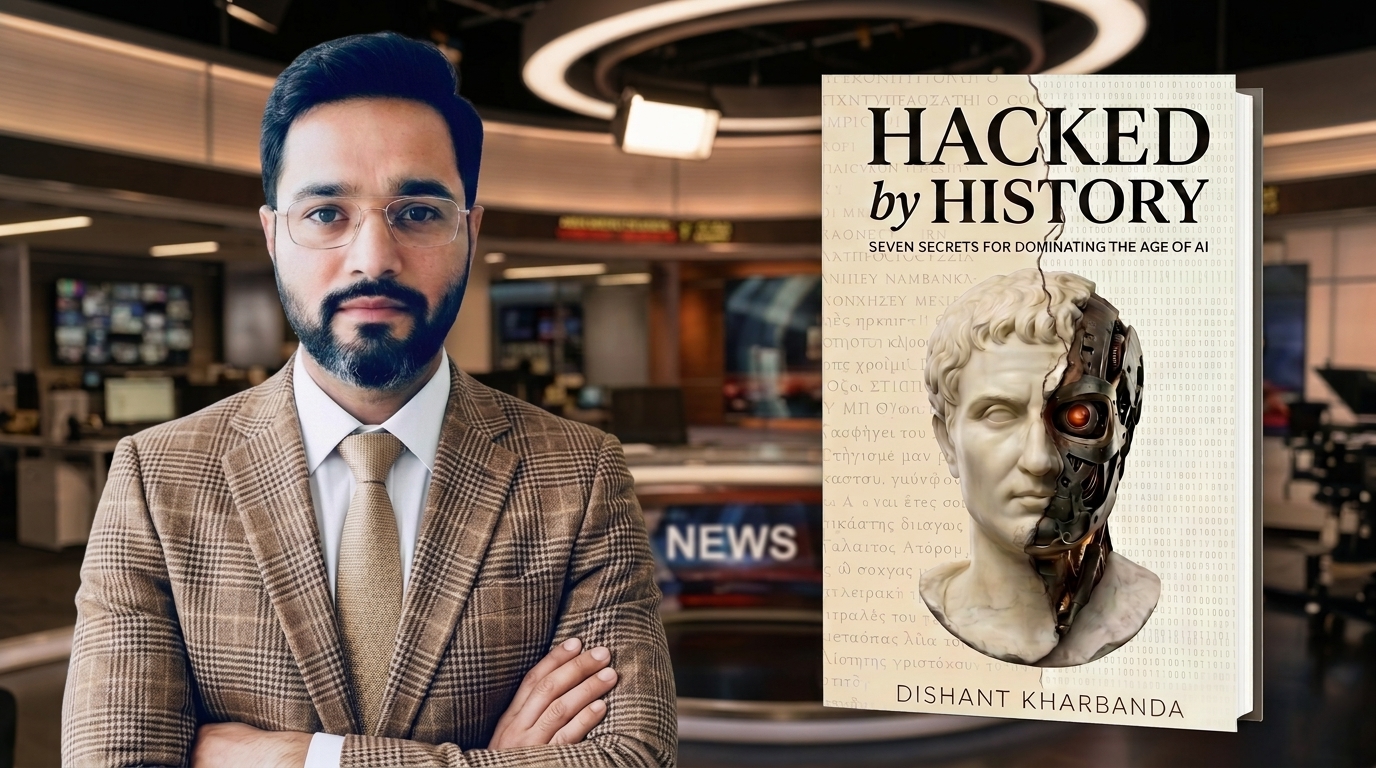
India,21 April 2026:-Dishant Kharbanda’s debut traces seven lives across three thousand years to answer the question AI is forcing on all of us: what makes a human being irreplaceable?
At a time when the global conversation about artificial intelligence is dominated by capability benchmarks, job displacement forecasts, and regulatory debates, a new book is making an unusual argument: that the most important preparation for the AI era was written not in code, but in the lives of seven historical figures who lived between the sixth century BCE and the thirteenth century.
Hacked by History: Seven Secrets for Dominating the Age of AI, by Dishant Kharbanda, is not the book its title might suggest. It is not a manual. It is not a guide to prompt engineering or a forecast of which industries artificial intelligence will reshape next. It is, unexpectedly, a work of narrative history and philosophy — one that draws on figures ranging from Socrates to Genghis Khan to make the case that the capacities which will matter most in the decades ahead are not technical. They are ancient.
History as survival manual
The cast is deliberately eclectic. Kharbanda weaves their stories in a style that owes a clear and acknowledged debt to Yuval Noah Harari — gripping, accessible, and relevant.
Each story follows a three-chapter structure: the history, told with narrative force; the lesson, connected to the specific challenges of living alongside artificial intelligence; and the future, explored through both optimistic and pessimistic scenarios. The argument that runs through all seven is simple and uncomfortable: the capacities that will matter most in the age of AI are not technical. They are ancient. Questioning. Presence. The courage to unlearn. Integrity. The ability to tell a story that means something. Simplicity. Trust.
The man behind the argument
Kharbanda is not an obvious candidate for this kind of book, which may be precisely why he was the right person to write it. He is an entrepreneur and educator who has spent nearly two decades in the education technology sector, most of it building things rather than theorising about them. His first major venture, a B2B edtech platform, grew under his leadership to become one of the world’s top 30k web portals and was recognised with the Most Innovative Edtech Enterprise award in 2013.
He completed the Advanced Executive Programme in Artificial Intelligence at IIM Calcutta and earlier he had studied fundamentals of pedagogy at the University of Helsinki. He delivered his first public talk on AI’s implications for education in 2017 — the year Google published the transformer architecture paper that would eventually power the tools now reshaping every sector.
Today, alongside the book, he is building an AI-first platform in the global student mobility space. He also serves as Deputy Programme Architect of the Socratic Fellowship alongside Emeritus Professor David Faulkner, former Director of the MBA and co-founder of the Saïd Business School, University of Oxford. It is, by any measure, an unusual combination — startup founder, academic collaborator, and now author of a book that argues that a barefoot philosopher from fifth-century Athens has more to teach you about artificial intelligence than most technology commentators.
The uncomfortable question
The book’s central provocation is not about technology at all. It is about identity. If a machine can diagnose a patient faster than a doctor, draft a contract faster than a lawyer, and compose a symphony faster than a musician, then the assumptions on which most people have built their professional identities — I am valuable because I know things, because I can do things — are standing on a foundation that is quietly disappearing.
Kharbanda does not pretend to have the answer. What he offers instead are seven historical examples of human beings who faced comparable displacements — of certainty, of centrality, of identity — and found, inside themselves, something that held. The argument is not that history repeats. It is that the human capacities worth cultivating have remained remarkably consistent across three thousand years, and that the people who cultivated them most intensely tended to be the ones who navigated the worst disruptions most successfully.
Whether the book delivers on this promise is for the reader to judge. But the ambition is unmistakable, the storytelling is compelling, and the timing — as Copernicus might have appreciated — could hardly be better.
In the words of Professor Faulkner (Oxford) — “I couldn’t put it down. It is utterly brilliant. I can honestly say it is the best social philosophical mini-treatise I have ever read.”
Hacked by History: Seven Secrets for Dominating the Age of AI by Dishant Kharbanda is available now.
For more information visit: https://dishantkharbanda.com/
To buy the book: https://dishantkharbanda.com/books/hacked-by-history
